Off-Page SEO: How to Build Google Trust for Your Business

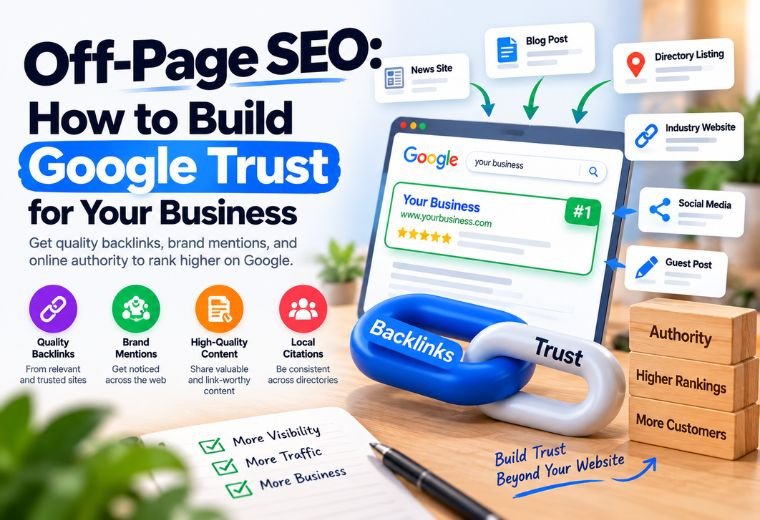
Quck Answer: Off-page SEO is everything you do outside your website to earn Google’s trust — backlinks, online reviews, local citations, and social signals. For Indian small business owners, the fastest wins come from Google Business Profile reviews, local directory listings, and links from local websites. Done right, off-page SEO brings in customers who are already searching for what you sell.
Off-Page SEO: How to Build Google Trust for Your Business
Table of Contents
Your website is ready. Pages are clean. Keywords are in the right places. But you’re still not showing up on Google. Sound familiar?
That’s often an off-page SEO problem.
On-page SEO tells Google what your business does. Off-page SEO tells Google how trustworthy your business is. Google won’t rank a website it doesn’t trust — no matter how well-written the content is. Think of it like a recommendation system. The more credible people and websites vouch for you, the more Google believes you’re worth showing to searchers.
This guide breaks down exactly what off-page SEO is, why it matters for your business, and what steps you can take starting today. No jargon. No fluff. Just a clear, practical plan — built specifically for Indian small business owners like you.
(This article is part of NayaLogic’s beginner SEO series. If you haven’t read the earlier posts on what SEO is and on-page SEO, start there first — they’ll give you the foundation you need.)
What Is Off-Page SEO?
Off-page SEO refers to all the actions taken outside your website that influence how Google ranks your pages.
The biggest factor? Backlinks — links from other websites pointing to yours. When a trusted website links to your business, Google reads it as a vote of confidence. More quality votes = more trust = better rankings.
But backlinks aren’t the only thing. Off-page SEO also includes:
- Online reviews (especially on Google)
- Local directory listings (like JustDial, Sulekha, or IndiaMart)
- Social media signals — shares, mentions, and engagement
- Brand mentions — even when no link is included
All of these signals tell Google one thing: this business is real, active, and trusted.
Why Off-Page SEO Matters for Indian Small Businesses
Here’s a simple way to think about it.
Ravi runs a dental clinic in Dehradun. His website is neat, loads fast, and mentions “dental clinic in Dehradun” in all the right places. But his competitor — Dr. Sharma down the road — has 80 Google reviews, is listed on three local directories, and gets mentioned in a Dehradun health blog. Who does Google rank higher?
Dr. Sharma. Every time.
Google ranks websites it can verify. Reviews, directory listings, and backlinks all act as verification signals. For clinics, salons, restaurants, and local service businesses, these signals are often the deciding factor between page one and page three.
The good news: off-page SEO doesn’t require a big budget. It requires consistency.
The 5 Core Off-Page SEO Strategies (and How to Use Each One)
1. How do backlinks work — and how do you get them?
A backlink is a link from another website to yours. Not all backlinks are equal.
A link from a well-known news site like Times of India carries far more weight than a link from a brand-new blog nobody reads. Google measures link quality by the authority and relevance of the source.
For small businesses, the most practical ways to earn backlinks are:
- Get listed on local directories. JustDial, Sulekha, Practo (for clinics), Zomato (for restaurants), MagicBricks (for real estate). These are trusted Indian platforms, and their links count.
- Partner with local businesses. A gym and a nutrition store can link to each other’s websites. A salon and a wedding photographer can do the same.
- Write a guest post. Contribute one useful article to a local blog or industry website. Most will link back to you.
- Join local business associations. Many Chamber of Commerce websites list their members — with links.
Start with directories. They’re free, fast, and Google trusts them.
2. Why are Google reviews one of the strongest off-page SEO signals?
Google reviews do two things at once: they build trust with new customers and they signal to Google that your business is active and credible.
A business with 50 genuine reviews almost always outranks a competitor with 10 — even if the website content is identical.
Here’s the simple system to get more reviews:
- Serve the customer
- Send a WhatsApp message asking for a review (include the direct link to your Google review page)
- Reply to every review — good and bad — within 24 hours
- Repeat every week
Replying to reviews matters. Google sees it as a sign your business is engaged. Use NayaLogic’s free Google Review Reply Generator to write professional responses in seconds — no writing experience needed.
Aim for at least 5 new reviews per month. That steady pace beats a burst of 30 reviews followed by months of silence.
3. What is a local citation — and which ones matter in India?
A local citation is any online mention of your business name, address, and phone number — even without a link.
Google uses citations to confirm your business details are consistent and real. If your address reads differently across three platforms, Google gets confused. Inconsistency = lower trust.
The key Indian directories to list your business on:
- JustDial
- Sulekha
- IndiaMART (for product businesses)
- Practo (for clinics and doctors)
- Zomato / Swiggy (for restaurants)
- MagicBricks / 99acres (for real estate)
- Google Business Profile (the most important of all)
Make sure your business name, address, and phone number are identical on every platform. One digit wrong in a phone number can weaken your local SEO.
4. Does social media actually affect SEO rankings?
Directly? No. Google has confirmed social media links don’t carry the same weight as backlinks from websites.
But indirectly? Yes — in two important ways.
First, social media increases your content’s reach. More reach means more chances that someone will see your post, visit your website, and eventually link to it. A kirana store owner in Pune who shares helpful grocery tips on Instagram might get picked up by a local blog. That blog link matters.
Second, social profiles themselves rank in Google. Search for any business name and you’ll often see their Instagram or Facebook page on the first page of results. That’s off-page SEO working for you — without building a single backlink.
The practical rule: Stay active on one or two platforms. Post consistently. Engage with comments. That activity builds signals Google pays attention to.
5. What are unlinked brand mentions — and do they help SEO?
An unlinked brand mention is when someone writes about your business online but doesn’t include a link to your website.
Google’s systems are sophisticated enough to understand these mentions as a trust signal. A local news article that says “Sharma’s Bakery in Lajpat Nagar served 500 customers this Diwali” builds your brand’s authority — even without a link.
How to get more brand mentions:
- Participate in local events and get covered in community pages
- Offer expert comments to local journalists or bloggers
- Run a promotion that people talk about online
- Encourage satisfied customers to tag your business on social media
These don’t require technical skill. They require showing up and engaging with your local community.
Off-Page SEO vs. On-Page SEO: What’s the Difference?
| On-Page SEO | Off-Page SEO | |
| Where it happens | Inside your website | Outside your website |
| What it tells Google | What your business does | How trusted your business is |
| Key actions | Keywords, headings, page speed | Backlinks, reviews, citations |
| Timeline | Faster to implement | Takes time to build |
| Can you control it? | Yes, fully | Partially — you earn it |
Both are essential. On-page SEO without off-page SEO is like opening a shop but telling no one it exists. Off-page SEO without on-page SEO is like word-of-mouth for a store with no signage. You need both working together.
If you haven’t tackled your on-page SEO yet, NayaLogic’s SEO service covers both — so nothing gets missed.
A Simple 30-Day Off-Page SEO Plan for Small Businesses
No big budget required. Just consistent effort.
Week 1 — Set up your foundation
- Claim and fully complete your Google Business Profile
- List your business on JustDial and one other relevant directory
- Make sure your name, address, and phone are identical across all platforms
Week 2 — Start earning reviews
- Ask your five best customers to leave a Google review
- Reply to every existing review on your profile
- Set up a simple WhatsApp message template to request reviews after each sale or service
Week 3 — Build your first backlinks
- Identify two local websites, blogs, or directories you can reach out to
- Contact one business you can partner with for a mutual link exchange
- Submit your business to one industry-specific directory
Week 4 — Amplify with content and social
- Share one useful tip on Instagram or Facebook relevant to your business
- Write one short article or tip you can pitch to a local website
- Respond to all comments and messages on your social profiles
Repeat this cycle every month. Results from off-page SEO typically take 3 to 6 months to show clearly in rankings — but the trust you build compounds over time.
Your Next Step: Let Google Find Your Business
Off-page SEO builds the trust that gets your business found. Reviews, backlinks, citations, and social signals — together, they tell Google you’re the real deal.
Start small. Claim your Google Business Profile. List on two directories. Ask five customers for a review this week. Then build from there.
If you’d rather have an expert handle it — book a free demo with NayaLogic. We’ll look at where your business stands online right now and show you exactly what to fix first. No setup fee. No pressure. Just a clear picture of what’s possible.
Frequently Asked Questions
How long does off-page SEO take to show results?
Most businesses start seeing movement in 3 to 6 months. It depends on how competitive your industry is and how actively you build links, reviews, and citations. Local businesses in smaller cities often see results faster than those competing in big metro markets.
Is off-page SEO necessary if I already have a good website?
Yes. A well-built website earns traffic only when Google trusts it. Off-page SEO — through backlinks, reviews, and citations — is how you build that trust. One without the other limits your results.
What are the best free off-page SEO tools for small businesses?
NayaLogic’s free LSI Keyword Generator helps you find keyword variations worth targeting in your off-page content. The Google Review Reply Generator makes managing reviews fast and professional. Both are free to use.
Can I buy backlinks to rank faster?
Avoid this. Google actively penalizes websites with paid or spammy backlinks. A penalty can remove your site from search results entirely. Earn links through quality content, local listings, and genuine relationships — it’s slower, but the results last.
What is the most important off-page SEO action for a local Indian business?
Google Business Profile reviews. They directly influence your local rankings and build customer trust at the same time. Start here before anything else.
Do social media followers improve my Google ranking?
Not directly. Follower count is not a Google ranking factor. But an active social presence increases your brand’s visibility, drives traffic to your website, and raises your chances of earning backlinks from people who discover your business online.